
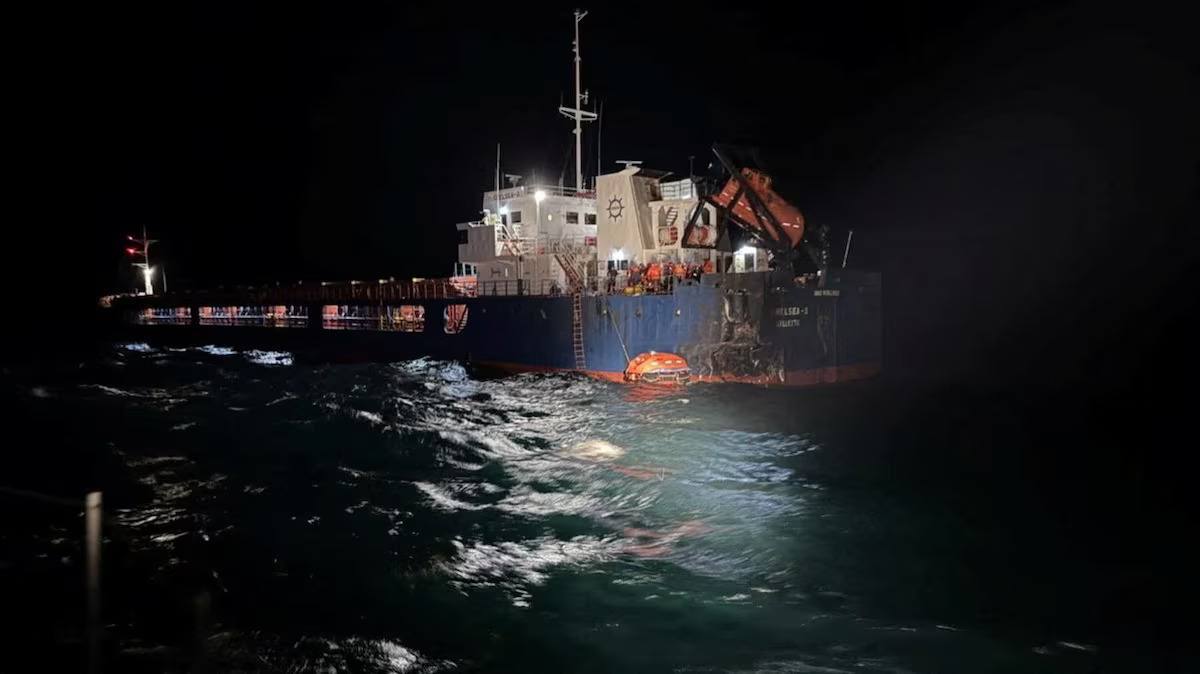
Photo via ndtv.com
Ship Sinks Off Bulgaria in Latest Drone Attack
Two merchant vessels struck in Black Sea; 11 crew missing as Sofia summons Russian ambassador.
What happened
Two merchant ships were struck by drones off Bulgaria's Black Sea coast overnight on October 12-13, with one vessel sinking and leaving 11 sailors missing. The Guinea-Bissau-flagged cargo ship HS Dignity went down 17 nautical miles east of the town of Krapets, with five crew members rescued and 11 still missing as of Tuesday afternoon. A second vessel, the Ukrainian-owned Chelsea 3 sailing under Maltese flag, was hit by three drones about 18 nautical miles off the coast of Byala but all 15 crew members—seven Ukrainians and eight Azerbaijanis—were rescued with five receiving minor medical treatment.
Bulgarian Prime Minister Rumen Radev condemned the attacks as unacceptable and summoned Russia's ambassador to Bulgaria, though he stated there was no conclusive evidence of who carried out the strikes. Radev said the outcome "benefits the Russian Federation," and Bulgaria is seeking support from NATO and the EU to investigate and strengthen maritime surveillance. Russian Ambassador Eleonora Mitrofanova told Radev she had no information from Russia's defense ministry about attacks on commercial vessels in the Black Sea but did not rule out they could be a provocation by a third party.
The attack marks the second sinking of a cargo ship in Bulgaria's Black Sea waters within a week. A week earlier, nine Syrian sailors and one Egyptian were lost when a vessel sank following drone strikes in Bulgaria's exclusive economic zone. The recurring attacks have prompted NATO chief Mark Rutte to say the alliance would adjust its defense posture as needed, and European Commission President Ursula von der Leyen called the Black Sea "another front of escalation of the Russian war in Ukraine."
Chanakya's Move
If these attacks are Russian-executed, they serve to harass NATO's southeastern flank without direct military escalation—creating pressure on Bulgaria and the EU while plausibly deniable. Bulgaria's response (summoning the ambassador, seeking NATO/EU support) is exactly what Moscow might expect: formal protest without military retaliation, and activation of NATO machinery that diverts resources to maritime defense. Ukraine frames this as spillover from the Russo-Ukrainian war and weaponization of hunger (via disruption of grain exports). The real strategic move—whether by Russia or Ukraine—is to test whether attacks on civilian shipping in NATO-adjacent waters trigger a unified NATO response or fragmented, muted complaint.