
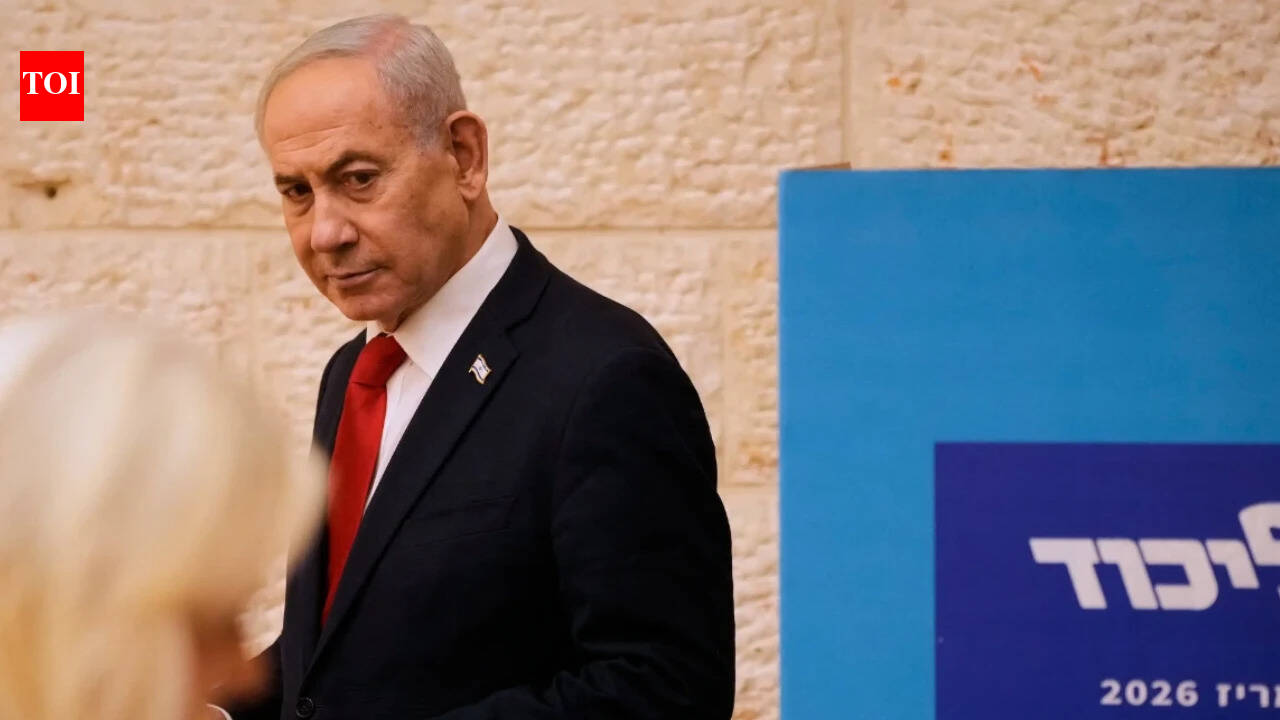
Photo via timesofindia.indiatimes.com
Netanyahu Seeks Broad Coalition After Election Loss
After failing to delay vote certification, Israel's PM pivots to coalition-building with rivals, explicitly excluding Arab parties.
What happened
Benjamin Netanyahu's Likud party came first in Israel's October 27 election with 27 seats, but his coalition bloc fell short of a majority with just 53 of 120 Knesset seats. The opposition bloc, led by former military chief Gadi Eisenkot, won 48 seats, while Arab-led parties surged to a record 19 seats. Neither bloc reaches the 61 seats needed to govern.
On Monday, Netanyahu abandoned his earlier effort to delay election certification over claims of foreign interference—a request the elections committee rejected. He then shifted tactics, calling for a "broad national government" under his leadership that would include his current allies plus any other party willing to join, provided they "oppose terrorism." He explicitly ruled out a coalition dependent on Arab parties.
Netanyahu's condition effectively excludes the Joint List and Ra'am, whose combined 19 seats plus the opposition bloc's 48 would give Eisenkot a majority of 67. The opposition has begun its own coalition talks, with Arab parties backing Eisenkot for prime minister. President Isaac Herzog will nominate a candidate, who then has 28 days (extendable by 14) to assemble a majority. Previous government-formation efforts have taken 20 to 100 days.
Chanakya's Move
Netanyahu's pivot from challenging the election to courting a broad coalition is a strategic retreat masquerading as a reset. Having lost his majority, he cannot reconstitute his current bloc alone. His play is to delegitimize the Arab parties as beyond the pale (framed as "supporting terrorism") and make coalition membership conditional on this exclusion—both to fragment opposition efforts and to appeal to center-right figures in Eisenkot's camp who fear electoral backlash from Arab partnership. The counter-move is clear: Eisenkot must either deliver a stable coalition within his own bloc plus Arabs (proving Arab parties are legitimate partners), or trigger another election where Netanyahu's bloc likely fractures further. Liberman's Yisrael Beytenu (7 seats) has already ruled out joining Netanyahu; Bennett's B'Yachad is positioned to be a swing vote. The hidden bet is whether defections or abstentions can paper over the arithmetic—or whether Israeli democracy forces a fifth election in four years.