
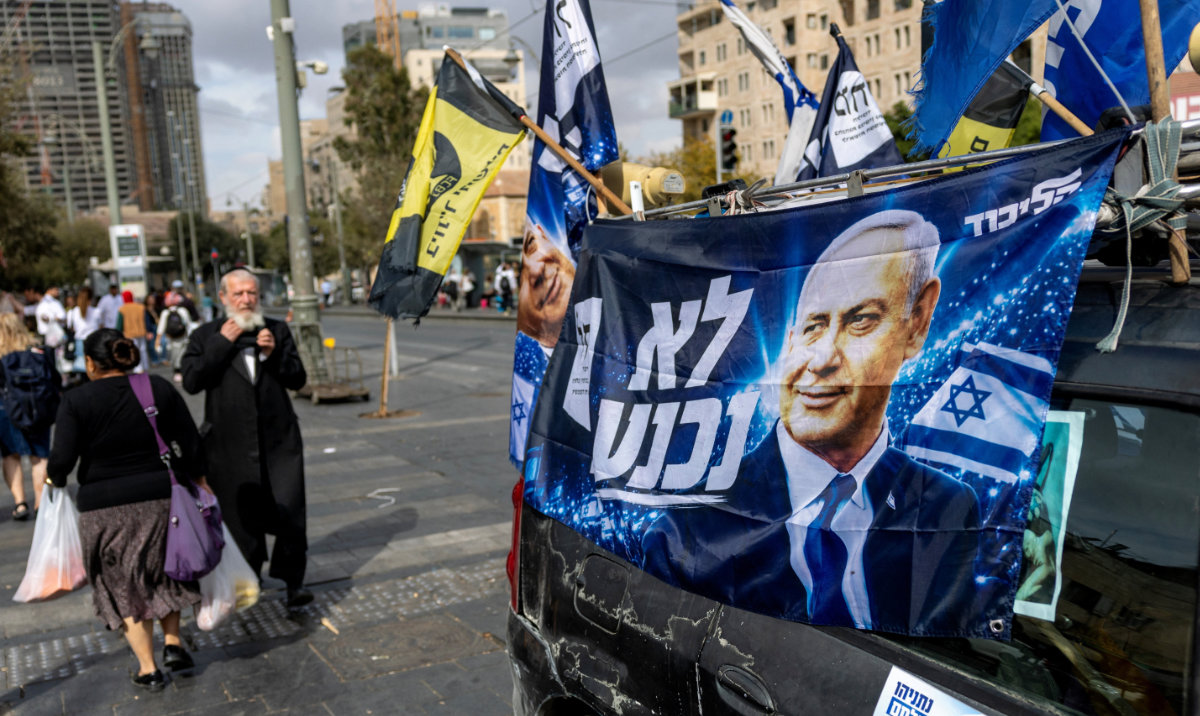
Photo via arabnews.com
Netanyahu and Eisenkot Locked in Tight Race Before Israeli Election
October 27 vote could decide whether Israel moves definitively toward hard-right nationalism, with both candidates struggling to secure a coalition majority.
What happened
Israelis head to polls on October 27 in a consequential election shadowed by the October 7, 2023 Hamas attack that killed about 1,200 people and sparked a three-year regional conflict. Prime Minister Benjamin Netanyahu, Israel's longest-serving leader at 77, is seeking a new mandate after directing military operations across Gaza, Lebanon, and Iran. His main challenger is former IDF Chief Gadi Eisenkot, who leads the centrist Yashar party and has positioned himself as Netanyahu's antithesis—a political novice prioritizing unity over rallying a nationalist base.
Polls show both camps deadlocked, with Netanyahu's coalition and Eisenkot's opposition bloc each hovering around 50-53 seats, far short of the 61 needed to form a government. Neither candidate has secured clear coalition backing, raising the prospect of prolonged post-election negotiations or a caretaker government. The election crystallizes competing visions: Netanyahu's hard-right coalition—bolstered by far-right allies bent on reshaping Israel as a religious-nationalist state—versus an opposition united mainly by opposition to Netanyahu's style, though not fundamentally his war policies.
Chanakya's Move
Netanyahu's wager is that war-time polarization and public security concerns outweigh corruption allegations and judicial threats he faces. His coalition has fragmented rightward (to far-right parties), reducing his own seat count from 32 in 2022 to projected 20 now, forcing reliance on ideological allies. Eisenkot's counter-move is to present himself as a security-credible alternative who can unite centrists and right-wing pragmatists without the hard-right ideological overlay—but his refusal to credibly include Arab parties (on which a non-Netanyahu majority likely depends) leaves him also short of a clear path to 61 seats. Both are banking on the other falling further short, or on post-election coalition surprises. The real strategic question is whether deadlock itself becomes the outcome: if neither reaches 61, Netanyahu remains in a caretaker role indefinitely, avoiding new elections (which some analysts see as a tacit Netanyahu strategy).