
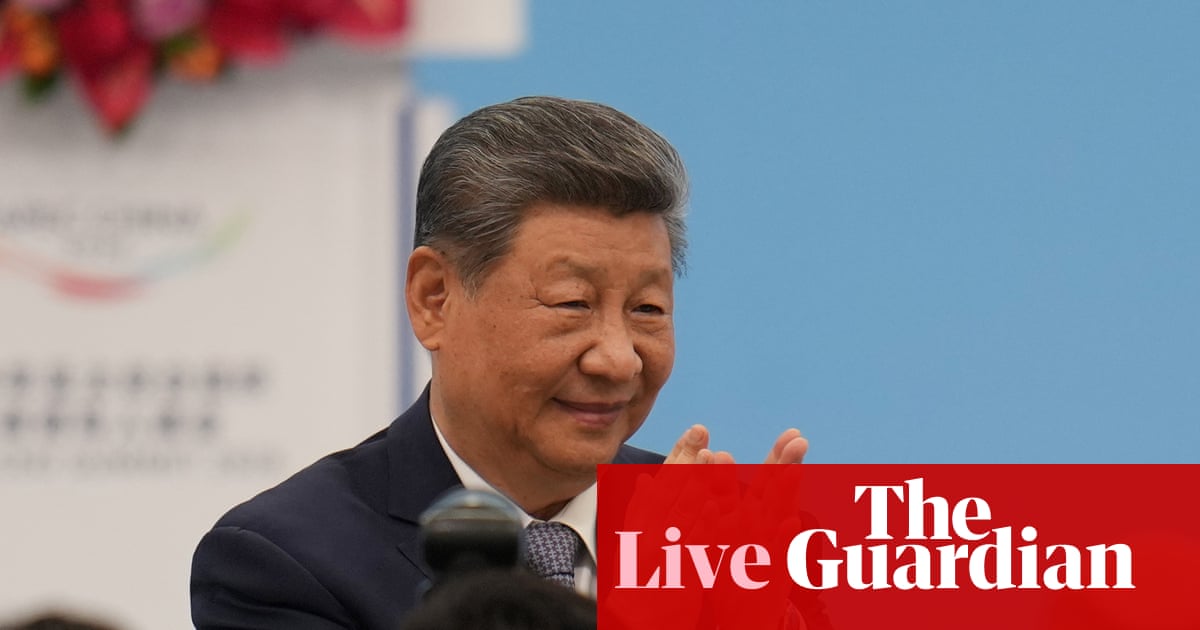
Photo via theguardian.com
Trump, Xi, Putin convene historic trilateral in Shenzhen
The first-ever three-way meeting of the nuclear-armed powers' leaders takes place during APEC, with limited progress expected on nuclear arms control.
What happened
Three of the world's most powerful leaders—US President Donald Trump, Chinese President Xi Jinping, and Russian President Vladimir Putin—are gathering in Shenzhen for an unprecedented trilateral summit on the sidelines of the Asia-Pacific Economic Cooperation (APEC) leaders' meeting on November 18-19. Putin arrived early Wednesday morning and received the highest-level airport welcome among foreign leaders, greeted by Politburo Standing Committee member Cai Qi. Trump was expected to arrive Wednesday afternoon from Manila, where he had attended ASEAN talks.
This marks the first trilateral meeting among the leaders of the US, Russia, and China. The White House signaled that Trump's priority is to include both China and Russia in a new nuclear proliferation treaty, though a senior official cautioned that "we do not expect to get any kind of agreement." China has explicitly resisted joining negotiations it had no role in forming, with its Foreign Ministry stating it would be "neither fair, reasonable nor realistic" to ask China to join such talks at this stage. Iran has emerged as a secondary focus, with Trump indicating he wants to discuss the Middle East conflict, though White House aides had earlier stated Ukraine would not be a central focus—a position Trump himself walked back by Monday.
The summit takes place amid significant anxiety in Europe, Japan, and Taiwan about potential great-power deals struck without their participation. European officials expressed "palpable anxiety" over what could be negotiated behind closed doors, with comparisons to the 1945 Yalta Conference, where Roosevelt, Churchill, and Stalin divided post-war Europe. Polish Foreign Minister Radosław Sikorski argued the summit should include the EU, while Ukrainian officials warned that the gathering without European representation could embolden Putin. Analysts noted low expectations for substantive breakthroughs, with Xi expected to be diplomatic but unlikely to concede on major issues. The Trump-Xi meeting represents their third encounter this year, following summits in Beijing in May and Washington in September.
Chanakya's Move
Xi is using his APEC chairmanship to position China as a diplomatic convener among the world's nuclear powers, lending legitimacy to Beijing's role in global security while showcasing technological prowess in Shenzhen. Trump is betting that high-visibility trilateral talks will reset his global image after domestic electoral setbacks and signal dealmaking strength before the December G20. Putin sees the meeting as rehabilitation—a return to great-power parity on the world stage despite international isolation over Ukraine. The move is Xi's: by hosting and setting the agenda, Beijing controls the optics and frames the meeting as China-led multilateralism, not a bilateral US-Russia arrangement. What could counter it: substantive European or Japanese intervention before Thursday, explicit statements from Xi refusing to decouple from Western allies, or Trump pivoting the agenda to issues (Taiwan, tech competition) where US-China interests diverge more sharply than on nuclear arms or Iran.