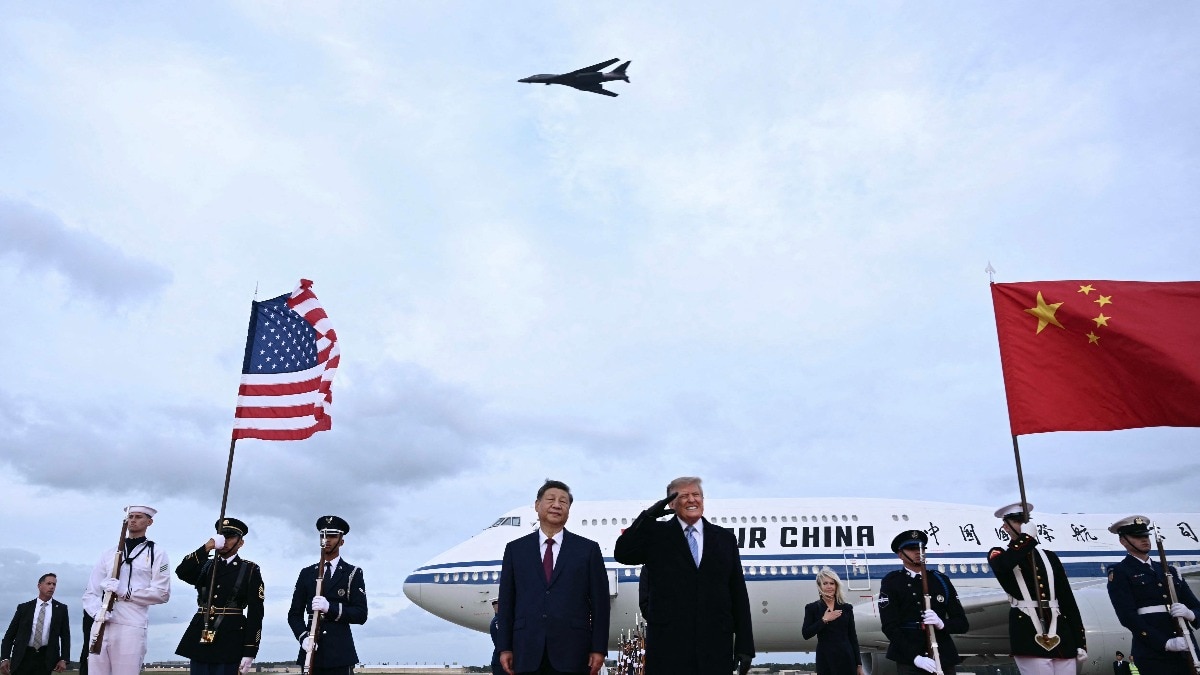
Trump Stages Competing Flyovers: B-2 for Putin, B-1 for Xi
As China's president arrives for high-stakes talks, the White House deploys two different strategic bombers within 24 hours—a new diplomatic grammar the Trump administration is writing with hardware.
On September 23, as Chinese President Xi Jinping stepped off his plane at Joint Base Andrews near Washington, two B-1B Lancer bombers thundered overhead in a surprise flyover that was not on the published schedule. The next day, as he stood on the White House's South Lawn, a B-2 Spirit stealth bomber flanked by four F-22 Raptors roared past in a scheduled ceremony. This marks the second time Trump has surrounded a major power's leader with strategic bombers: in August 2025, Russian President Vladimir Putin's arrival at Alaska's Joint Base Elmendorf-Richardson was met by a B-2 stealth bomber and F-35 fighters. The pattern suggests the Trump administration views bomber flyovers as a new form of state-visit diplomacy—simultaneous displays of friendliness and latent force. Xi remained composed during the B-1 passage, while Trump visibly flinched at the noise and afterward remarked, "That was really loud." The White House released no official explanation for the B-1's presence, but analysts note the aircraft's strong association with Bomber Task Force missions over the South China Sea and Taiwan Strait, territories where China views US military operations as provocative. Meanwhile, the B-2—designed for stealth penetration of advanced air defenses and carrying nuclear ordnance—has historically been reserved for strategic messaging to nuclear-armed adversaries. Both bombers saw recent combat: B-1s and B-2s flew together in operations against Iran earlier this year. Whether the choice of different bombers for different rivals signals something specific—Xi gets speed and regional familiarity; Putin gets stealth and nuclear reach—or is simply operational availability, no Pentagon official has said.
How could this affect you
Traced by who's actually in the path of this — not everyone is.
Possible
US defense contractors and military analysts
The normalization of strategic bomber flyovers at state visits could drive demand for these platforms in an era of deliberate strategic signaling, and set a precedent for how future administrations stage diplomatic events.
Likely
Beijing observers of US-China policy
If the B-1 was chosen to reference US military activity in the South China Sea and Taiwan Strait, it could signal that trade negotiations and diplomatic warmth do not mean a shift in US military posture toward Taiwan or the broader region—a message relevant to Xi's broader calculus about how much ground to give in talks.
Possible
US-Russia negotiators
The precedent of meeting Putin with a B-2 signal could shape expectations for future summits, where failure to deploy advanced aircraft could be read as a diplomatic retreat or decline in seriousness about deterrence.
Sources
Every claim here traces back to reporting you can read yourself.