
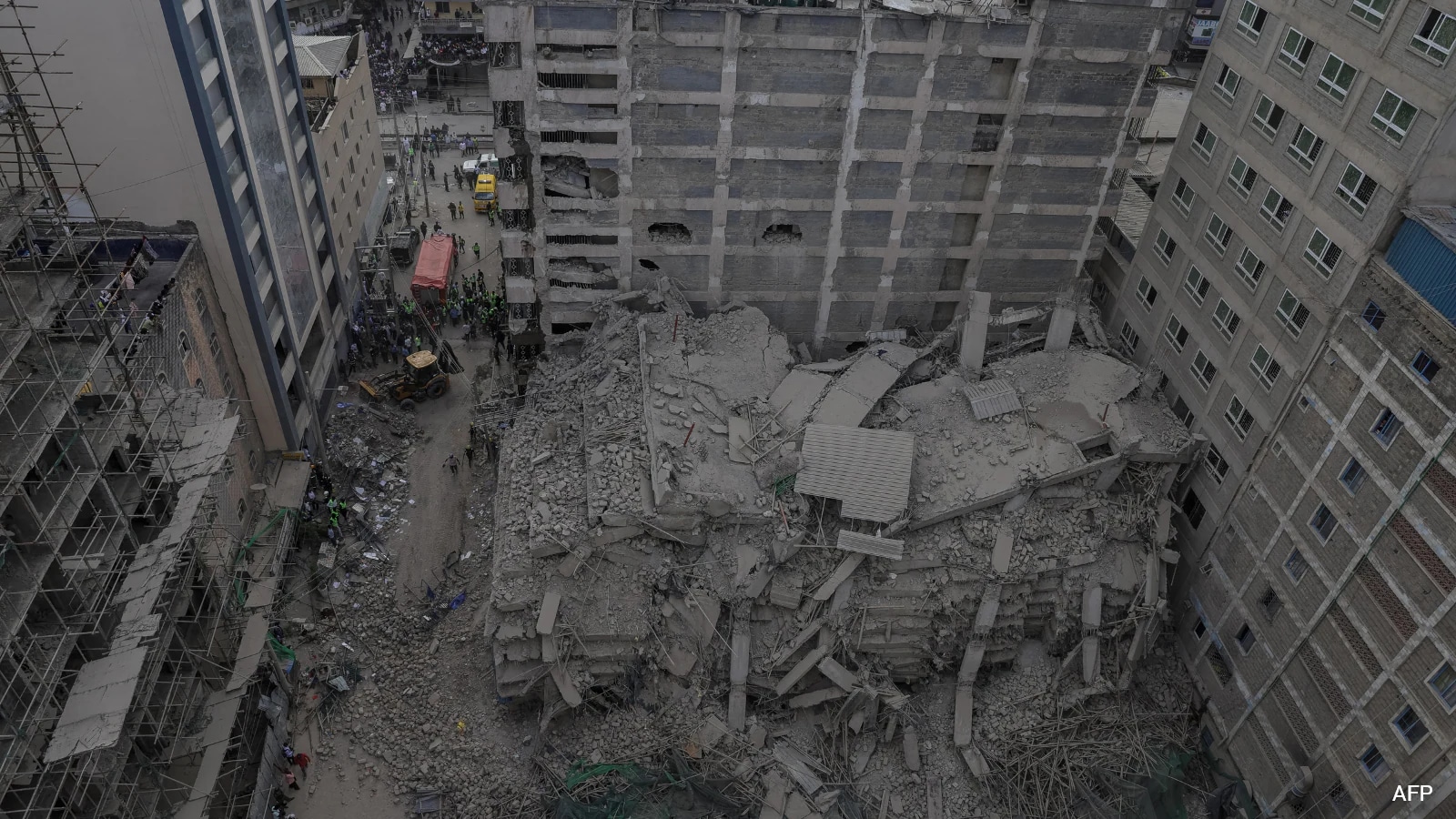
Photo via ndtv.com
Multi-storey building collapses in Nairobi's Eastleigh
An 18-storey structure under construction fell in the busy commercial district on Friday, trapping an unknown number of people amid continued rescue efforts.
What happened
An 18-storey building under construction collapsed in Nairobi's Eastleigh neighborhood on Friday, October 23, at approximately 1:40 PM, leaving a vast heap of concrete rubble and compressed steel. Multiple people are feared trapped beneath the debris, though authorities have not confirmed a specific number. By Friday evening, rescue teams had confirmed one confirmed rescue and two injured people taken to hospital.
The building, located along Yusuf Haji Avenue near Day to Day Supermarket, had been approved for construction but lacked an occupation certificate—the formal authorization required for occupancy. Despite this, the ground floor was occupied with shops and rental units operating while construction continued above. Nairobi Governor Johnson Sakaja said the missing certificate "has potentially cost lives" and called for stronger enforcement powers and higher penalties for developers who violate regulations.
Engineering experts at the scene reported that workers had observed visible distress signs, including cracks in columns, minutes before the collapse. The building sits tightly wedged between other high-rises in Eastleigh, a dense commercial hub and center of Kenya's Somali community, which initially hampered rescue access. Kenya Red Cross teams, police, and civil defense personnel are conducting ongoing search and rescue operations.
Chanakya's Move
Governor Sakaja has seized on the disaster to publicly demand stronger enforcement authority and higher penalties for developers. His move signals intent to shift blame from county oversight failures to developer negligence, reframing the regulatory gap as a penalty problem rather than an enforcement problem. This positions him to seek legislative changes that expand his executive power while appearing to champion worker and public safety. The underlying challenge is that Kenya's National Building Inspectorate found 87 percent of audited buildings nationwide failed to meet standards or lacked approvals—a systemic failure that no penalty level alone can resolve. Professional engineering bodies implicate unqualified personnel and ignored warning signs, suggesting that tighter rules without capacity-building may simply reshape rather than solve the problem. A counter-move by developers and construction firms could be to lobby for clarified standards and transition periods rather than punitive action, framing the issue as one of unclear requirements rather than wilful non-compliance.