
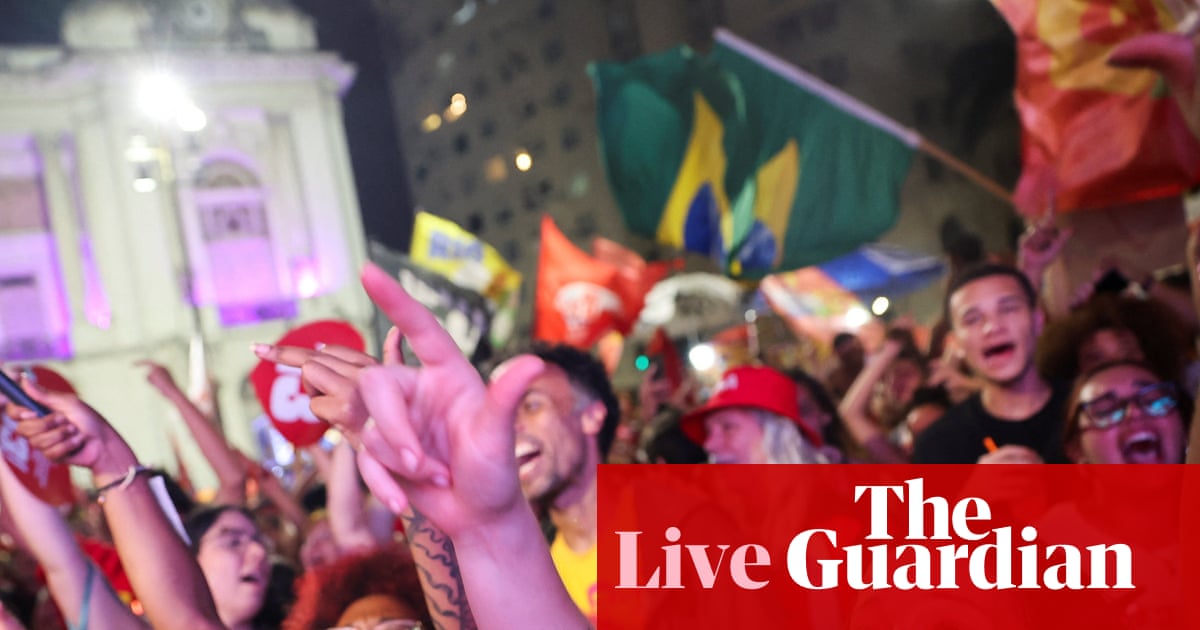
Photo via theguardian.com
Lula wins Brazil runoff in historic comeback after voting extension chaos
With 51.8%, the leftist incumbent defeats Bolsonaro in a bitterly contested runoff marked by last-minute voting extension and contested election-day logistics.
What happened
President Luiz Inácio Lula da Silva won Brazil's presidential runoff on October 25 with 51.76% of valid votes, defeating right-wing Senator Flávio Bolsonaro's 48.24%. The result marks a historic reversal: Bolsonaro had led by 2.2 million votes (47.03% to 45.16%) in the first round on October 4, making this the first time in Brazil's post-dictatorship era that the runner-up in the first round came back to win the runoff.
Lula's victory comes amid deep polarization and contested election-day mechanics. Hours before polls closed at 5 p.m., Lula's campaign requested a two-hour voting extension, citing reduced bus service in Bahia and São Paulo that it said prevented voters from reaching polling stations. Bolsonaro also sought an extension, citing heavy rain in southern states where his support was strongest. At 4:57 p.m., just three minutes before the scheduled close, Supreme Court Justice Cristiano Zanin granted the extension to 7 p.m. The timing created immediate chaos: the electoral court had already begun publishing partial counts showing Lula ahead, and some polling stations had already deactivated their voting machines and could not resume voting.
With the extension, Lula's campaign argued it was leveling an unlevel playing field. Bolsonaro initially objected and stated he would request annulment of the election, citing the circumstances. However, within hours, key Bolsonaro allies—including lower house leader Arturo Liras and São Paulo's newly elected governor—recognized Lula's victory, narrowing the political space for a formal legal challenge. The margin of victory was the narrowest since Brazil's return to democracy, with Lula defeating Trump ally Flávio Bolsonaro by 3.65 percentage points.
Chanakya's Move
Lula's victory represents a strategic setback for Trump's hemisphere play. The incumbent leftist, a vocal Trump critic, defeated a Bolsonaro who had aligned himself closely with the Trump administration. Bolsonaro's bet was that a conservative, Trump-friendly alternative could capitalize on economic hardship and security concerns to displace an aging leftist incumbent. He nearly succeeded—winning the first round by 2.2 million votes—but Lula's campaign exploited a narrow opening: the late-hour transport crisis in Bolsonaro-aligned municipalities, which allowed it to force a voting extension that delivered urban voters to the polls late. Lula's move (requesting the extension) was tactical and perhaps crucial; Zanin's granting it was legally defensible but politically explosive given his prior role as Lula's lawyer. Bolsonaro's counter-move—initially refusing to concede—failed to gain traction once his own allies defected. The real strategic question is whether this result hardens or fragments the conservative bloc in Latin America. Trump will likely seek to rebuild relationships with Brazilian conservatives and governors to maintain influence; Lula will position Brazil as a regional counterweight. Neither outcome is yet settled.