
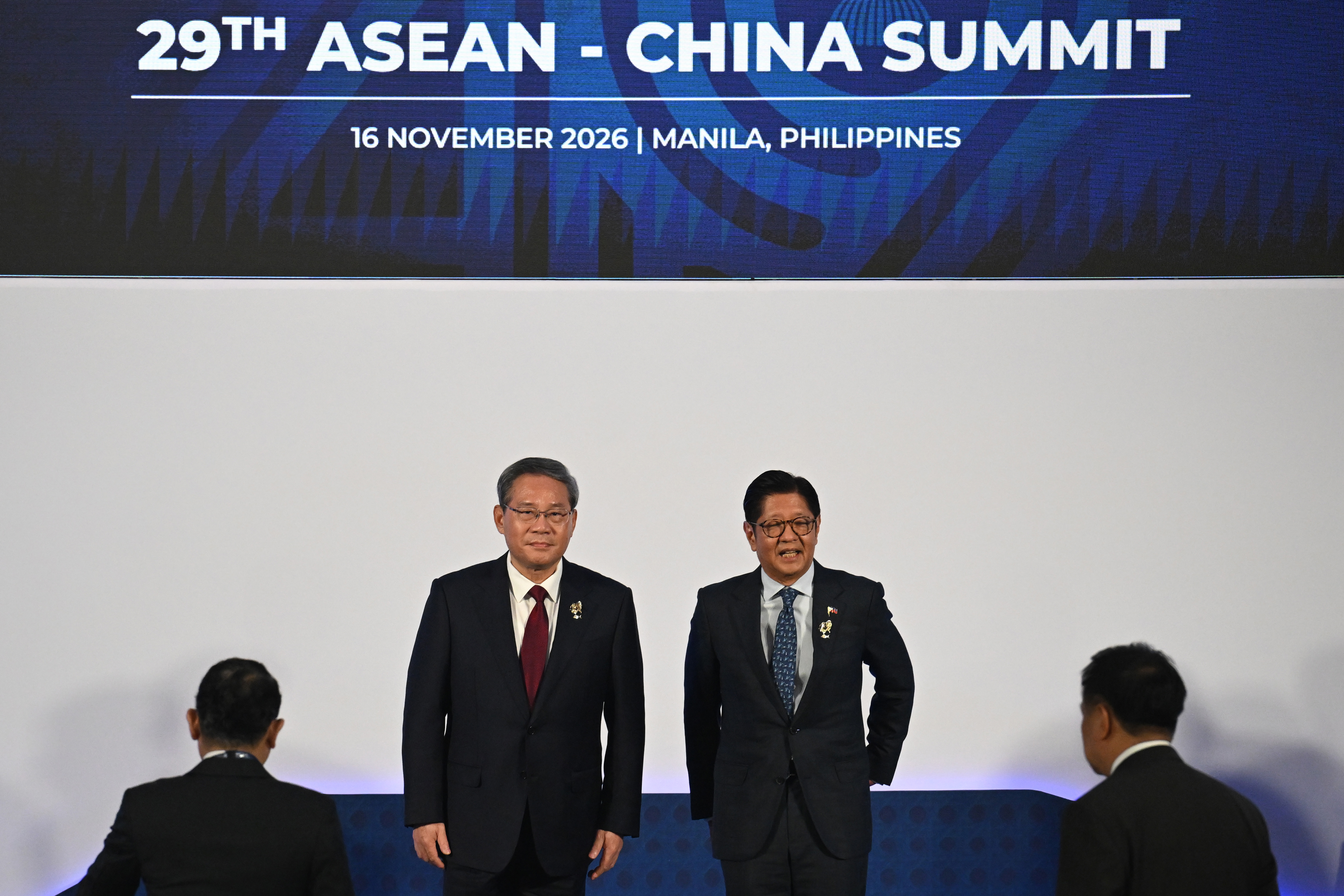
Photo via globalnation.inquirer.net
China touts ASEAN ties as South China Sea talks stall
Beijing emphasized economic partnership and trade worth over $1 trillion while negotiations on maritime conduct rules collapsed and the Philippines bolstered defense ties.
What happened
Chinese Premier Li Qiang arrived in Manila for the 29th ASEAN-China Summit on November 16, highlighting expanding trade and investment between China and the ten-nation bloc. Li praised what he called "truly extraordinary" achievements between China and ASEAN, noting that two-way trade exceeded $1 trillion last year—up 20.1 percent from 2021—and grew another 29.6 percent in the first ten months of 2026. He also highlighted the signing of an upgraded China-ASEAN Free Trade Agreement and connectivity milestones including railways and canal projects. Li's remarks underscored Beijing's push for free trade and regional unity "against interference" at a time of growing global protectionism.
Simultaneously, negotiations on a Code of Conduct to manage South China Sea disputes failed to reach conclusion. The Philippines, as ASEAN chair, had prioritized finalizing the two-decade-old process this year, but foreign minister Maria Theresa Lazaro announced on November 15 that negotiators had reached only provisional agreement on about 80 percent of the draft. Key unresolved issues include whether the code would be legally binding and its geographical scope. ASEAN claimants want the code grounded in international law, which some have accused Beijing of disregarding; China maintains its actions have been lawful.
On the security front, the Philippines and Australia signed a Defense Cooperation Arrangement on November 15 to accelerate military coordination including joint patrols and exercises. In a joint statement on November 16, the two leaders expressed grave concern about "coercive, aggressive, and dangerous actions against Filipino nationals and vessels" in the South China Sea, without naming China. The agreement extends a broader Philippines strategy of deepening defense ties with Australia, Japan, and the United States amid repeated confrontations with Chinese vessels.
The dueling narratives reflect the Philippines' difficult balancing act: maintaining multilateral economic engagement with China while militarily fortifying against Beijing's regional assertiveness. Li's emphasis on trade and cooperation masks unresolved maritime tensions that have stalled diplomatic progress toward a binding code.
Chanakya's Move
China's move: Beijing deployed Premier Li Qiang to Manila to present itself as a champion of multilateralism and free trade—a pointed contrast to anticipated US protectionism under Trump. By highlighting $1 trillion in trade, free trade upgrades, and connectivity projects, Li sought to deepen economic dependencies binding ASEAN to China and to create diplomatic momentum suggesting cooperation, not confrontation. The timing—just before Trump's arrival—positions China as the region's economic anchor. Meanwhile, allowing Code of Conduct talks to stall on the legal binding question is consistent with Beijing's long-term strategy of avoiding codified limits on its maritime behavior while claiming to negotiate in good faith. What China is betting on: that economic interdependence and the appeal of infrastructure investment will outweigh security concerns among ASEAN capitals, particularly those less assertive than the Philippines. That the Code's failure will normalize indefinite negotiations, reducing pressure for formal restraints on Chinese actions in the disputed waters. Counter-move: The Philippines and Australia's defense pact timing is deliberate—signed during ASEAN to show that security partners can deliver tangible cooperation where multilateral negotiations stall. The joint statement on "coercive" Chinese actions publicly documents the problem the Code was meant to solve, strengthening a narrative that Beijing cannot be trusted in maritime governance. Trump's imminent arrival amplifies this signal: Washington's return to active Indo-Pacific engagement offers Manila an alternative to patient multilateralism.