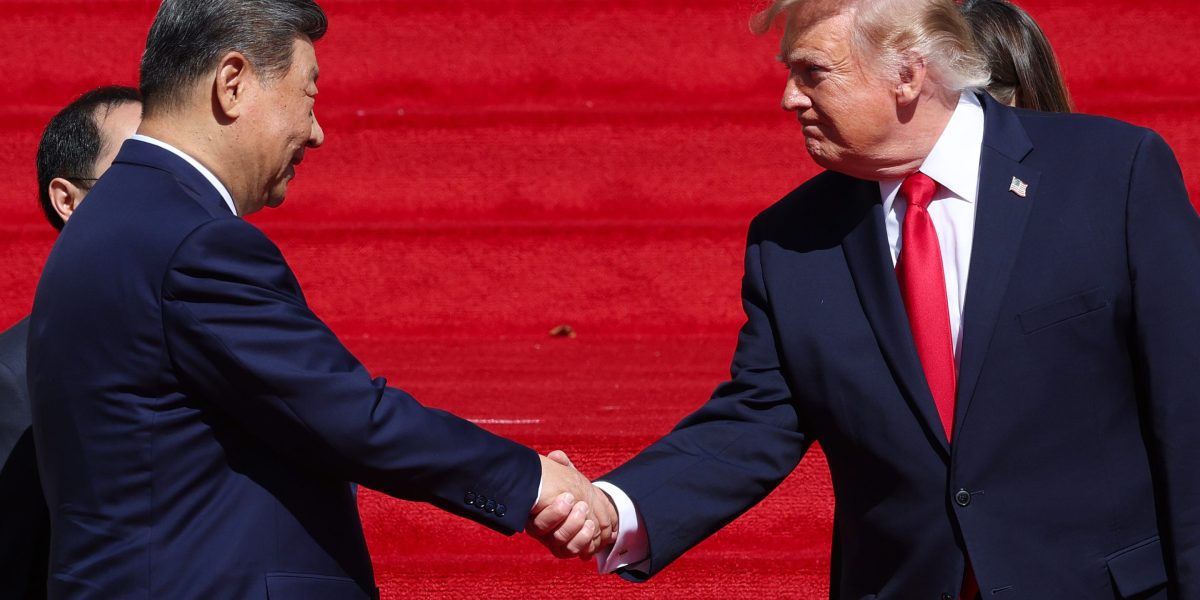
The two leaders agreed to keep talking, but concrete breakthroughs on trade, AI, and Taiwan remain elusive—and analysts question whether the ceasefire will hold.
President Donald Trump hosted Chinese President Xi Jinping in Washington from September 24-25 for a three-day state visit meant to reset relations between the world's two largest economies. The summit extended an existing trade truce by two months—to January 10, 2027—and produced agreements to establish an AI safety communication channel and form an agricultural working group to meet before year's end. The two countries also reached consensus on tariff reductions for roughly $30 billion of "non-sensitive goods" in each direction, focused on items like U.S. agricultural products, coal, cosmetics, and Chinese consumer goods.
But analysts say the summit was heavy on ceremony and light on substance. Trump personally greeted Xi at the airport—an unusually warm gesture—and the White House orchestrated a state dinner with over 140 guests, including tech titans like Elon Musk, Tim Cook, and Nvidia's Jensen Huang. Yet no major breakthroughs emerged. The two sides offered only tentative commitments on trade, with experts noting that deliverables on rare earths, refined oil, investment, and AI are "quite limited." Taiwan, a critical flashpoint, went unmentioned in official readouts from both sides, despite Xi pressing Trump to handle the issue "prudently." Export controls on advanced semiconductors and critical technologies—the real stakes in the tech competition—remain off the negotiation table.
Implementation remains the major test. China is already behind on a previous pledge to purchase $17 billion annually in U.S. agricultural products, and soybeans were notably excluded from the new tariff-cut list, continuing to face a 10% tariff. Treasury Secretary Scott Bessent acknowledged uncertainty about whether a larger deal could be reached by January. The agreements establish working groups, but Trump's own trade representative said detailed terms on which products qualify and when tariffs would change have yet to be released.
The summit also reflects Trump's political circumstances. He faces an Iran war that has stalled and rising inflation ahead of November midterms. China, for its part, secured a pause in escalation and validation of its rise as a legitimate economic partner—gains achieved through diplomacy rather than concessions. Both sides appear content with managed rivalry rather than resolution. They plan to meet again in November at APEC in Shenzhen and in December at the G20 in Miami, potentially providing stages for larger announcements later in the year.
How could this affect you
Traced by who's actually in the path of this — not everyone is.
Likely
U.S. agricultural exporters and commodity traders
China is behind on its $17 billion agricultural purchase commitment, and new tariff negotiations exclude soybeans, leaving core commodity sales uncertain. The two-month truce extension delays any resolution until January, risking continued volatility in soybean and grain prices.
Direct
Tech companies dependent on U.S.-China trade (semiconductors, AI hardware)
Advanced technology export controls remain outside the Board of Trade negotiations and are treated as national security issues, not negotiable trade items. Trump stated he does not want to open up AI competition, suggesting export controls will persist regardless of broader tariff deals.
Likely
Taiwan and regional U.S. allies
Taiwan did not appear in official summit readouts despite being a stated agenda item. Trump has approved arms sales to Taiwan in the past but signaled no immediate Taiwan announcement during the summit, creating uncertainty about U.S. commitment amid warming U.S.-China ties.
Possible
U.S. importers of consumer goods from China
The tariff agreement covers $30 billion of non-sensitive goods, including toys and small appliances. However, terms have not been finalized and implementation timing remains unclear, leaving tariff exposure uncertain through January.
Sources
Every claim here traces back to reporting you can read yourself.