
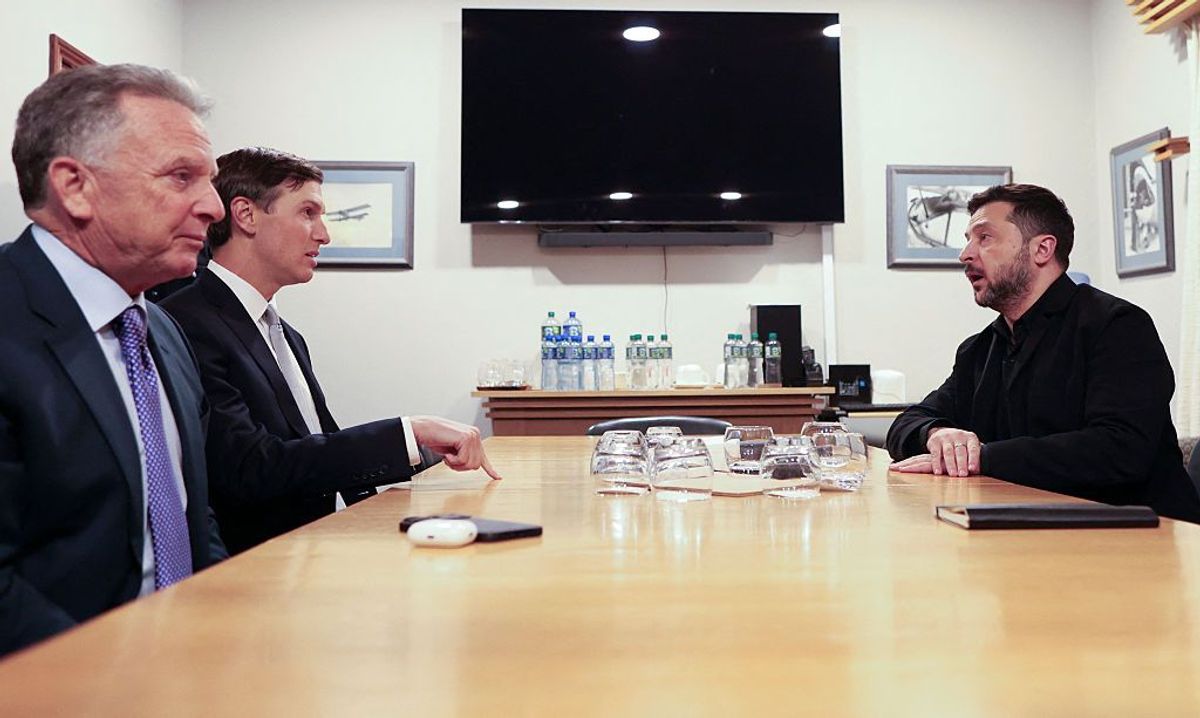
Photo via ndtv.com
Trump Envoys Shuttle Between Putin and Zelensky as Peace Talks Reset
After no breakthrough in Abu Dhabi, Kushner and Witkoff carried proposals to Moscow and Dublin, securing European involvement in future talks and a major prisoner exchange—but deepening territorial divisions remain.
What happened
President Trump's envoys Jared Kushner and Steve Witkoff moved rapidly through two capitals in a single day on November 12, meeting Russian President Vladimir Putin in Moscow and then Ukrainian President Volodymyr Zelensky in Dublin. The shuttle came immediately after two days of U.S.-mediated talks in Abu Dhabi that yielded a humanitarian agreement but no breakthrough on the core dispute: Russia's maximalist territorial demands.
In Moscow, Putin doubled down on his core position. He reaffirmed that any final settlement must reflect Russia's claimed state borders—the four regions it asserts to have annexed: Donetsk, Luhansk, Kherson, and Zaporizhzhia. He also flatly rejected any role for European peacekeeping forces, telling the envoys that their deployment would be "absolutely unacceptable" and that Russia would regard such troops as legitimate military targets, effectively threatening war's resumption. Putin did offer one limited concession: a five-day ceasefire in the contested city of Kostyantynivka to allow humanitarian evacuation of civilians.
The envoys succeeded on one point: securing Putin's acceptance of European representatives at future negotiating tables. This was a key ask from Ukraine and Europe, which argue their security interests must shape any settlement. A technical meeting with Finland, Ukraine, Russia, and the U.S. is expected in coming weeks.
In Dublin, Zelensky announced that Europe would join the next round of talks. The envoys also confirmed agreement on what Zelensky called "the biggest exchange of war prisoners yet," planned for within two or three weeks. Both sides signed off on a large-scale prisoner exchange in Abu Dhabi, marking modest humanitarian progress even as territorial and security guarantees remain in deadlock. Zelensky and his team, still rejecting any territorial concession, pressed for answers on Russia's conditions—questions the envoys could not resolve.
Chanakya's Move
Trump's move is to lock in European involvement and humanitarian wins while testing whether Putin will negotiate on terms rather than borders. Kushner and Witkoff are acting as honest brokers between maximalist positions, signaling flexibility on process (Europe at the table, prisoner swaps) to paper over the fact that territorial demands have not shifted. Putin's bet is that sustained U.S. mediation, combined with Europeans now formally involved, creates diplomatic pressure on Zelensky to concede territory—while Putin keeps his red lines intact and makes small humanitarian offers to show movement. Zelensky's counter-move is to lock in European support precisely to avoid a bilateral U.S.-Russia deal that bypasses Ukrainian security interests. The stalemate is structural: Russia wants territorial recognition and a weakened Ukraine; Ukraine and Europe want security guarantees and a sovereign state. Trump's envoys are trying to create motion by separating humanitarian wins (prisoner exchanges) from the political settlement (borders, NATO, peacekeeping), but neither side has signaled readiness to compromise on what matters most.