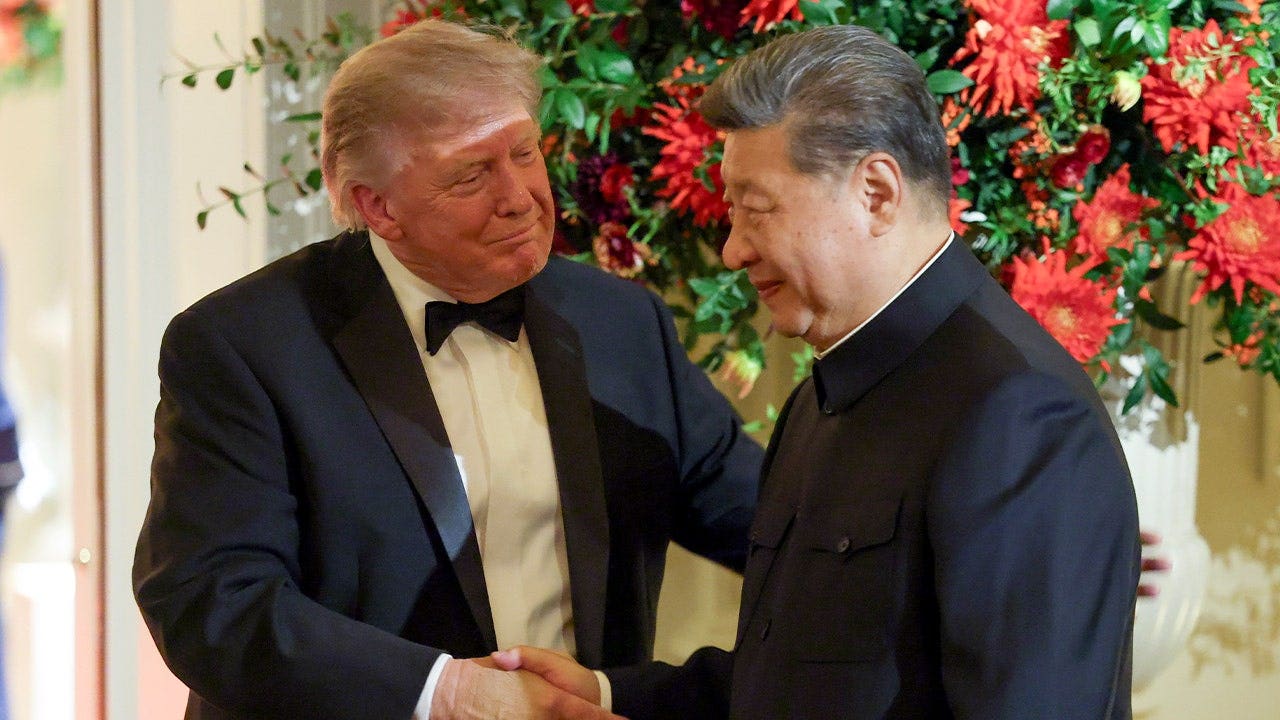
Trump and Xi extend trade truce but deliver little substance at glitzy summit
The leaders' three-day Washington meeting yielded a two-month tariff extension and pledges on fentanyl, but left major disputes over semiconductors, critical minerals, and Taiwan unresolved.
President Trump and Chinese President Xi Jinping concluded a three-day summit in Washington on September 25, marking their second face-to-face meeting this year and Xi's first state visit to the U.S. capital since 2015. Trump provided an unusually lavish ceremonial welcome—greeting Xi personally at the tarmac of Joint Base Andrews, hosting a state dinner, and offering a private Marine One tour—in an apparent bid to reinforce his personal relationship with the Chinese leader as the anchor of bilateral stability. The summit proved heavy on pageantry but light on concrete deliverables. Treasury Secretary Scott Bessent announced that the two countries had agreed to extend their existing trade truce by two months through January 10, 2027, a far shorter extension than the year-long reprieve analysts had expected. Both countries also announced the establishment of an "AI Dialogue" and a working group on agricultural trade, though details remained sparse. On fentanyl, the White House pointed to China's August arrest of 21 nationals based on U.S. intelligence and tightened controls on precursor chemicals, though Trump made clear he is still pressing Xi for permanent restrictions on additional chemicals. On critical minerals and semiconductors—two core U.S. concerns—no new comprehensive agreements emerged. Unresolved disputes over Taiwan, rare earth exports, and cyber threats also found no place in either side's official readout, signaling limited progress on these long-standing friction points.
How could this affect you
Traced by who's actually in the path of this — not everyone is.
Direct
Companies reliant on U.S.-China trade
The two-month extension of the trade truce through January keeps tariff rates stable at current levels, but creates near-term uncertainty as the deadline approaches without resolution of underlying trade imbalances or semiconductor and rare earth disputes.
Likely
U.S. manufacturers and importers of Chinese goods
While tariffs remain frozen until January, the fragility of the agreement and absence of progress on core disputes could lead to renewed tariff escalation when the extension expires, raising costs for supply chains dependent on Chinese inputs.
Likely
Investors in U.S. technology and defense sectors
The lack of movement on semiconductor export controls and rare earth access suggests continued strategic competition on advanced technology, potentially limiting U.S. access to critical supply chains and keeping technology sector valuations volatile.
A working group on agricultural trade was announced to begin before year-end, but the absence of new purchasing commitments from China leaves prior expectations of expanded agricultural imports unmet, limiting near-term revenue gains.
Sources
Every claim here traces back to reporting you can read yourself.