
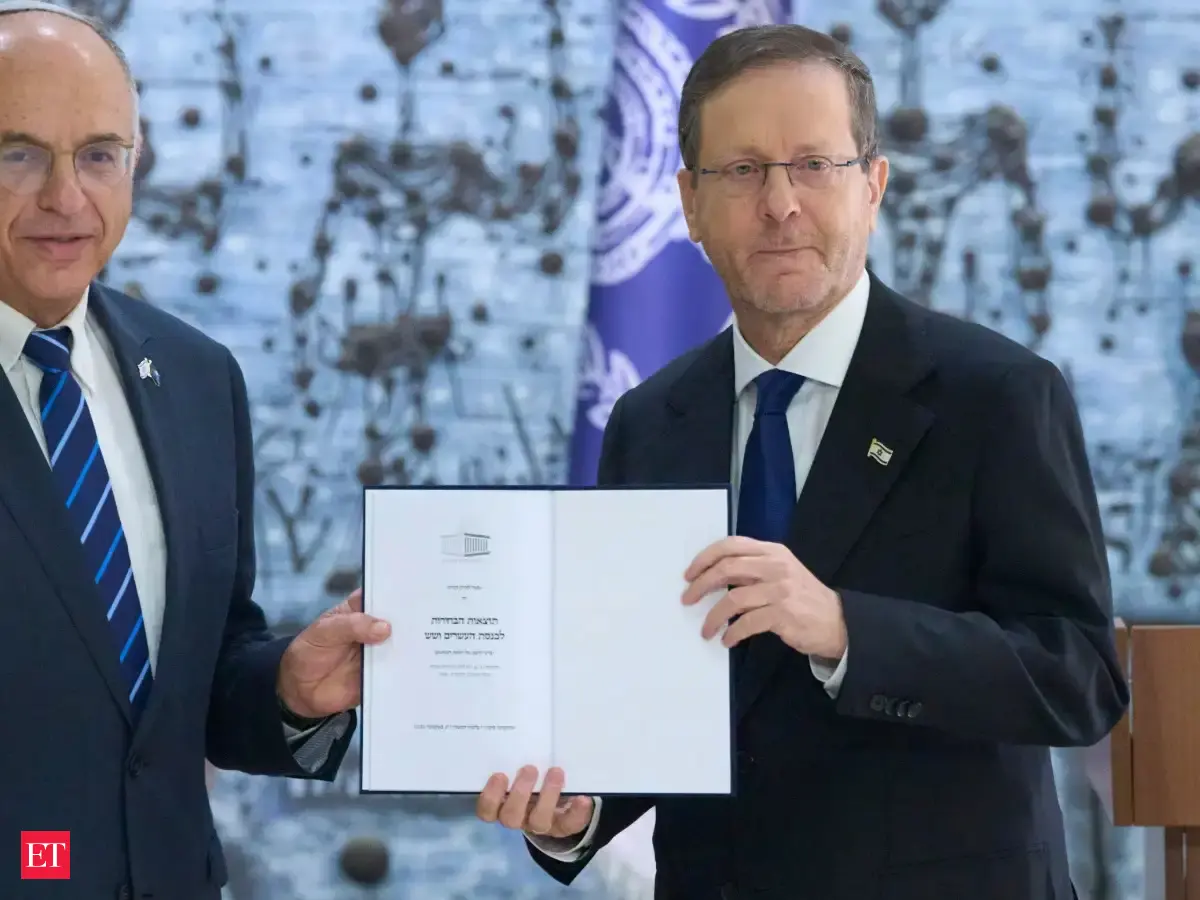
Photo via economictimes.indiatimes.com
Herzog Accepts Election Results, Starts Coalition Talks
Israel's president formally certified last week's parliamentary vote and began consultations on choosing between Netanyahu or opposition leader Eisenkot to form a government.
What happened
Israeli President Isaac Herzog on Wednesday accepted the certified results of October 27 elections and began consultations with party leaders to determine who should attempt to form a government. The elections commission found no evidence of fraud, directly contradicting Netanyahu's claims that Arab-led parties had stolen the election. Herzog urged both camps to compromise, warning that "not every commitment and promise can be fulfilled," and emphasized the need to avoid another election.
Netanyahu's bloc won 53 seats, below the 61 needed for a majority. The opposition alliance secured 48 seats, while Arab-led parties achieved a historic 19 seats—enough to give an opposition coalition 67 seats if combined with the Arab parties' support. Arab parties have already recommended opposition leader Gadi Eisenkot to Herzog as their preferred candidate.
Netanyahu's far-right allies have separately recommended him. After concluding his consultations, likely within days, Herzog will task one candidate with 28 days to form a coalition, with a possible 14-day extension. If that fails, another round of negotiations or a new election could follow.
Chanakya's Move
Herzog's formal certification and the elections commission's rejection of Netanyahu's fraud claims represent a decisive institutional move to lock in the results and prevent delegitimization. Netanyahu bet that early and loud fraud allegations could either block the vote's certification or poison the political environment enough to force concessions from other blocs. That gambit failed—the institutions held, and the fraud narrative has collapsed. Now the game shifts to coalition math. Eisenkot's advantage is clear: he has 48 opposition seats plus 19 Arab party endorsements (67 total), while Netanyahu's 53 votes go nowhere without the haredi parties, whose demands are steep and whose loyalty to him is conditional. Eisenkot is likely to receive the first mandate. His counter-bet is that he can assemble either a haredi coalition or, if necessary, a minority government with Arab support—politically radioactive for him but mathematically viable. Netanyahu's move now is to prevent that by either blocking haredi parties from joining Eisenkot or fragmenting the opposition before Herzog decides. The coalition contest is not won or lost in the next week—it plays out over the next month in marathon negotiations where each side tests what the other will concede.