
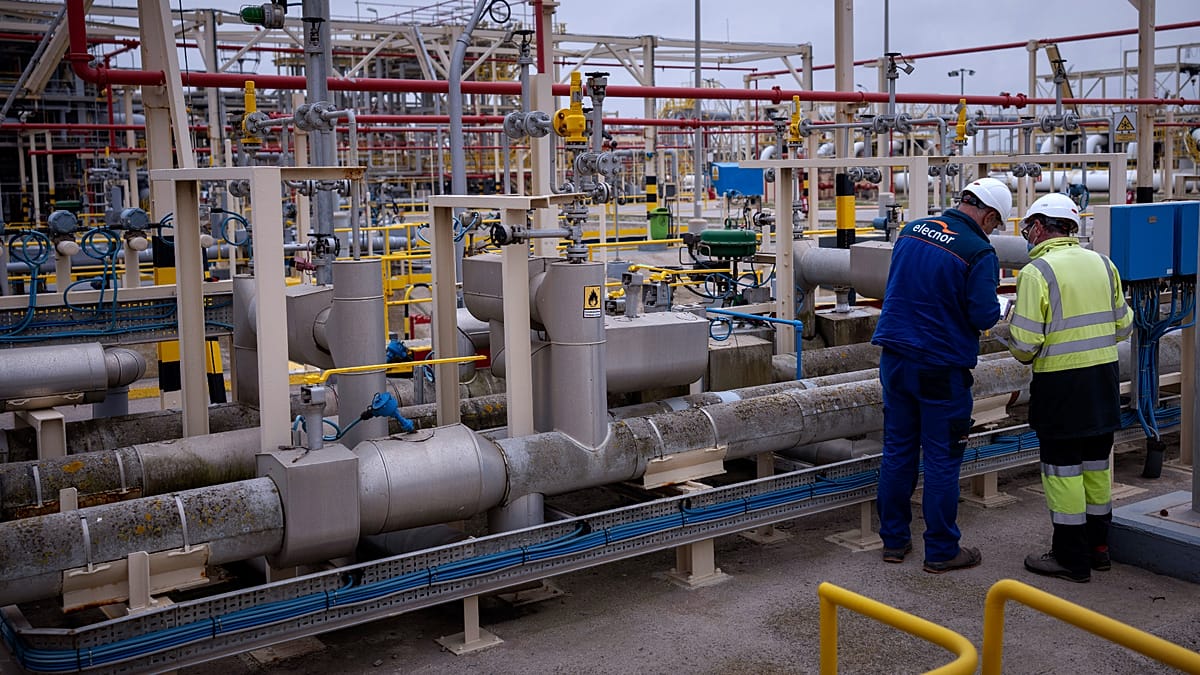
Photo via euronews.com
European gas price hits €100/MWh as winter supply crisis looms
Benchmark prices reached their highest since 2022 amid Middle East disruptions and record-low storage, just as demand season begins.
What happened
Europe's natural gas benchmark briefly crossed €100 per megawatt-hour on October 28 for the first time since the 2022 energy crisis, as the region heads into peak demand season with unusually tight supplies. The Dutch TTF contract, the continent's price reference, spiked more than 4% to trade at €100.37/MWh in afternoon trading before settling slightly lower. The milestone coincided with EU Energy Commissioner Dan Jørgensen's public warning that Europe faces "another energy crisis" and a difficult winter.
The price surge reflects a combination of structural constraints. Since the Iran war began in late February, disruptions to Strait of Hormuz shipping have removed roughly 80% of liquefied natural gas exports from Qatar and the UAE—a loss equivalent to about 300 million cubic metres of gas supply daily. Qatar, normally Europe's third-largest LNG source, invoked force majeure on shipments after attacks damaged its liquefaction facilities. Europe's gas storage stands at just 75% as of late October, well below the EU's 90% target for November 1, and some countries report storage below 60%. Winter-to-summer refilling costs have risen sharply since the war began, making storage injection economically unattractive during the warm months when demand should have been building inventory.
Europe's response has shifted from Middle Eastern sources to growing dependence on US suppliers. The US now accounts for roughly 60-70% of EU LNG imports in 2026, up from 57% in early 2025. Analysts at Goldman Sachs warned in August that prices would need to exceed €100/MWh to suppress global demand enough for Europe to manage storage through winter. The continent also competes with Asia for available cargoes, particularly as cold weather forecasts emerge and lower wind and solar generation increase gas demand for power generation and heating.
Countries like Germany and France face particular exposure: German front-year baseload electricity contracts hit 159.30/MWh—their highest since June 2023—while France's reached 122.50/MWh. Though current prices remain far below the 2022 peak of €340/MWh, they have tripled since the Iran war began and are driving costs across industry and household bills. The EU has already spent €17.9 billion in 2026 subsidizing energy costs for households and firms.
Chanakya's Move
This is a supply-shock story with a geopolitical hinge. The US-led war against Iran disrupted 20% of global LNG supply by closing the Strait of Hormuz and forcing Qatar's force majeure. Europe, having abandoned Russian pipeline gas, is now forced to compete on global LNG spot markets where it bids against Asia and pays premium prices. The €100 threshold matters because it signals that demand destruction (rationing, reduced consumption) is now needed to restore market balance—Goldman Sachs' August forecast proved accurate. EU strategy has shifted from energy independence (post-2022) to energy dependence on the US, which controls roughly 60-70% of incoming LNG. High prices suppress demand and force storage, but only if prices remain elevated through winter; any signal of Hormuz recovery or warmer weather will collapse prices and reduce urgency for substitution (renewables, efficiency). Europe is betting on a mild winter and continued high US LNG exports; a cold winter or a US policy shift on energy exports could force rationing. The strategic asymmetry is real: the US can supply gas and set terms; Europe must buy and adjust.