
Photo via euronews.com
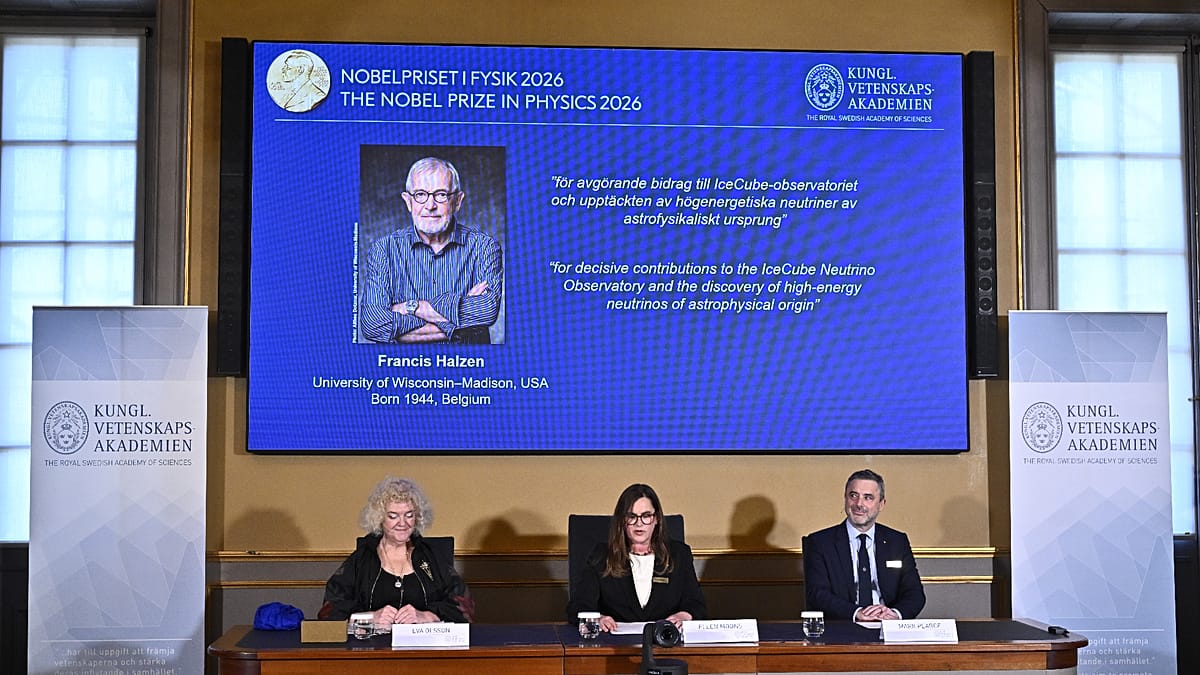
Belgian physicist Francis Halzen wins Nobel Prize in Physics for Antarctic neutrino observatory
Halzen honored for decades of work building the IceCube detector, which unlocked a new form of astronomy by capturing rare cosmic particles from deep space.
What happened
Francis Halzen, an 82-year-old physicist at the University of Wisconsin–Madison, has been awarded the 2026 Nobel Prize in Physics for his decisive contributions to the IceCube Neutrino Observatory and the discovery of high-energy neutrinos of astrophysical origin. Halzen first presented his vision in 1988 for using Antarctic ice to detect neutrinos—elusive particles that rarely interact with matter. Construction of the observatory began in 2005 and was completed in 2011.
The IceCube detector occupies a cubic kilometer of pristine ice, buried 1.5 to 2.5 kilometers below the South Pole surface near the Amundsen-Scott Research Station. When a high-energy neutrino collides with an atomic nucleus in the ice, it produces a flash of light that is captured by 5,160 optical sensors embedded in 86 vertical strings. This design exploits Antarctica's clear, geologically stable ice and freedom from interference.
The observatory has successfully detected high-energy neutrinos originating from astrophysical sources far beyond our galaxy, including from distant galaxies and violent cosmic accelerators such as black holes and exploding stars. These discoveries have established what scientists call a new form of astronomy: neutrino astronomy, which reveals cosmic phenomena hidden behind dust clouds and provides information complementary to traditional telescope observations.
The Nobel Prize, worth SEK 12 million (approximately $1.2 million), will be awarded in Stockholm on December 10. Halzen becomes Belgium's 11th Nobel laureate. At the announcement, Halzen noted he is working on a proposal to expand IceCube to monitor eight cubic kilometers of ice—a project he hopes the prize recognition may help secure funding for.